2026 Guide · Company formation in Mexico for foreigners
How to incorporate your company in Mexico as a foreigner
Real steps, exact documents, costs and timelines.
Before you continue
This guide will help you, but if you fall into any of these cases you need advice
We wrote it so you can handle the process on your own. In the cases below, however, going it alone almost always ends up costing more time and more money. In those cases we solve it for you.
How long it actually takes
With Mexican shareholders, the full process takes 2 to 3 months.
With foreign shareholders, 3 to 6 months.
The difference is not in the law. It is in the appointments with the SAT (Mexico’s tax authority), in documents that must be apostilled and translated, and in bank verifications that can reject your address if something does not add up. We get it done in about 1 month.
What you need before you start
A real tax address
The SAT does not accept just any address. You need proof of address issued no more than 4 months ago: a bank statement, or an electricity, water, landline or property tax bill. A lease agreement is no longer accepted as proof. If you use a virtual office, it must have real infrastructure, not just an address on paper.
A legal representative who fits the profile
This must be an individual, Mexican or a foreigner with a residence status that allows paid activities in Mexico, and registered with the RFC (the tax ID issued by the Mexican tax authority). Without this you cannot register the company or open a bank account.
Apostilled documents if your shareholders are companies
If a shareholder is a foreign legal entity, meaning a company and not an individual, its corporate documents and the power of attorney it grants must be apostilled in the country of origin and translated by an authorized expert translator. An apostille is the international certification that validates a public document from one country so it has effect in another. Planned well, this step takes 1 to 3 weeks. Planned badly, it can hold everything up for a month.
A signing plan if the shareholders are not coming to Mexico
Most notaries require individual shareholders to sign the incorporation deed in person. If they cannot travel, someone else can sign on their behalf through a power of attorney, which must also be apostilled and translated.
Do you fall short on any of these requirements?
That is not a dealbreaker. We have incorporated companies for shareholders who did not have everything sorted either, and our services cover exactly that part.
Which legal entity suits you
The difference between legal entities in Mexico is not about validity, they are all equally legal. It is about the corporate governance requirements each one imposes and how flexible it is to run.
The S. de R.L. de C.V. (limited liability company) is the one most used by companies with foreign capital, because it is the most flexible. It does not require a statutory auditor, an oversight role that supervises management, which lightens the compliance load. On top of that, if your parent company is in the United States, the IRS can treat it as a disregarded entity (check the box), which simplifies tax handling over there. It allows up to 50 shareholders.
The S.A. de C.V. (stock corporation) has more formal corporate governance: it does require a statutory auditor and a stricter shareholder meeting structure. In exchange, it has no cap on the number of shareholders, allows different classes of shares and makes it easier for shareholders to come in and out. It is worth it when the size or structure of the business calls for it.
The S.A.P.I. de C.V. (investment promotion corporation) is a variant of the S.A. designed to take on investment. It is the ideal vehicle if you plan to raise capital, bring in funds or investors, or eventually list shares publicly. It allows shareholder agreements and economic and voting rights arrangements that are far more flexible than a traditional S.A.
The SAS (simplified stock company) exists, but it is almost never the right option for foreigners. Only individuals can be shareholders, never companies. It has an annual revenue cap of just over 7.6 million pesos. And although a foreigner can be a shareholder, they need a valid e.firma to incorporate it, which in practice requires already having a Mexican tax ID. That is why almost nobody starting from abroad can use it.
In practice there is no mandatory minimum capital to incorporate an S. de R.L., an S.A. or an S.A.P.I. Very low capital can raise questions with banks and clients, so the norm is to declare capital in line with the size of your operation. All of these entities, except the SAS, require a minimum of 2 shareholders.
The 10 steps to incorporate your company
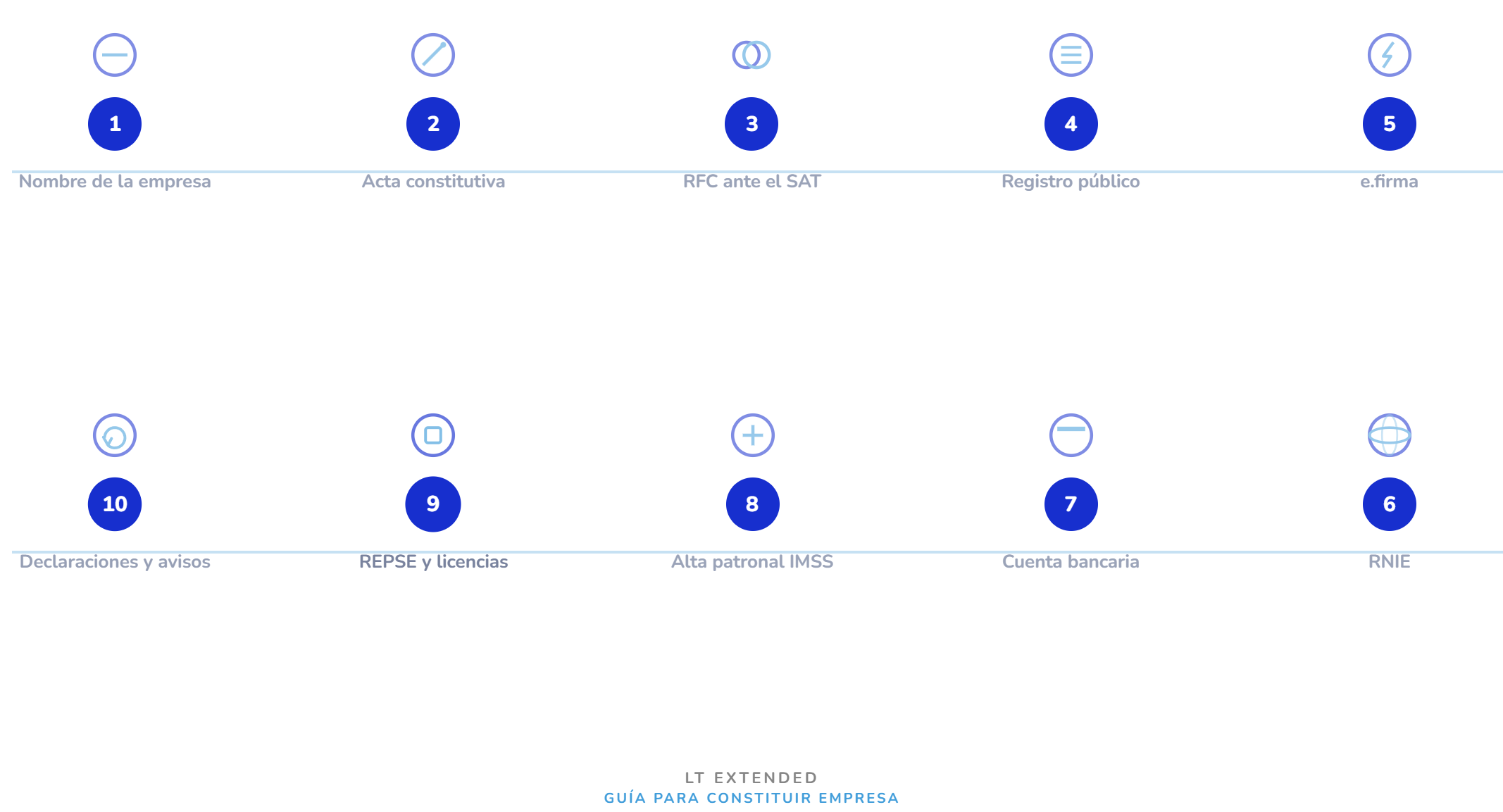
Before the steps, some context that catches many foreign founders off guard. Incorporating a company in Mexico looks nothing like the process in countries such as the United States or Colombia, where you practically do not need a physical presence, the process is very agile and almost everything is resolved online within days. In Mexico several different authorities are involved, some steps must be done in person, and the timeline depends on appointments you do not control.
In many cases you can handle the process on your own by following this guide. In others, like the ones listed above, outside advice stops being optional and becomes the difference between a clean process and months of delays. Our services exist precisely for those cases.
Step 1. Company name authorization
This is the permit from the Ministry of Economy to use your company’s name. They check that the name you want is not too similar to one that already exists.
The notary can request it, but in practice the process moves much faster if you request it yourself online and hand the approved authorization to the notary. To do it yourself you need the e.firma (advanced electronic signature) of the individual filing the request, not the company’s, since the company does not exist yet.
Time: from hours to a few business days. Validity once approved: 180 days. Cost: free.
Step 2. Signing the incorporation deed before a notary or public broker
In Mexico you cannot incorporate a company on your own or through a private document. The company must be incorporated before a notary public (notario público) or a public broker (corredor público), the officers empowered by law to formalize the act. Without that, the company simply does not exist.
Any authorized notary can handle it, but not all of them have the same experience with foreign shareholders, apostilled documents and powers of attorney granted outside Mexico, and that is where most delays come from. Official notary directories are looked up by state: the Colegio Nacional del Notariado Mexicano nationwide and, for the capital, the Colegio de Notarios de la Ciudad de México. Both links are in the resources section.
The notary drafts the bylaws: corporate purpose, management, capital and rules between shareholders. Review them carefully, this is where it is decided whether your company will be able to operate without friction later. If any shareholder is foreign, this is where the apostilled and translated documents are filed.
Time: 1 to 3 weeks once you have all the documents ready. Estimated cost: notary fees between $15,000 and $35,000 pesos plus VAT, depending on the city and the declared capital.
Are your shareholders companies, or unable to travel to sign? This is exactly where processes get stuck, and it is one of the things our services solve for you.
Step 3. Registration with the RFC before the SAT
This is the order that works best in practice: first the tax ID, then the Public Registry of Commerce. Once the deed is signed, the notary gives you a letter stating that the company is pending registration with the Public Registry. With that letter and the deed you can book your appointment to register the company with the Federal Taxpayer Registry (RFC), the number that identifies it before the SAT.
Documents: incorporation deed, the notary’s letter, valid official ID of the legal representative, a document proving their authority, and proof of the company’s address. If a foreign shareholder does not have an RFC, a generic key is used: EXTF900101NI1 for individuals or EXT990101NI1 for legal entities. The SAT issues a certificate of registration with the RFC.
Time: appointments can take 2 to 4 weeks to be assigned, depending on the city. Cost: free. SAT helpline (MarcaSAT): 55 627 22 728, Monday to Friday from 8:00 to 18:30. From abroad, the same number with the +52 country code.
Step 4. Registration with the Public Registry of Commerce
With the RFC registration certificate, you go back to the notary and they register the company with the Public Registry of Commerce (RPC). This registration is what gives your company full effect against third parties: without it, the company cannot fully exercise its commercial rights and obligations.
Time: 1 to 3 weeks. Cost: $1,000 to $5,000 pesos, depending on the state.
Step 5. Obtaining the e.firma
Once the company is registered with the RPC, a new SAT appointment is booked to obtain the e.firma, the advanced electronic signature your company uses to sign documents and file returns with the Mexican government. Without it, your company cannot operate for tax purposes. The legal representative needs their own valid personal e.firma before obtaining the company’s.
Documents: the formalized incorporation deed, official ID of the legal representative, a general power of attorney for acts of ownership or administration (apostilled and translated if granted abroad), and a USB drive to generate the files.
Time: another SAT appointment, which can take weeks to be assigned. Cost: free.
The SAT can take longer than you imagine to release these appointments. If you need to be operating in weeks and not months, our services speed up the process.
Step 6. Registration with the RNIE
If there is a single peso of foreign investment in your company, the law requires you to register with the Ministry of Economy in the National Registry of Foreign Investment (RNIE). You have 40 business days from the start of operations or from the moment the foreign investment enters the capital.
If you miss the deadline, the penalty ranges from 30 to 100 UMA per day, roughly 1,600 to 5,400 pesos a day. The filing is free and online, but it requires the incorporation deed, the tax ID certificate and documentation on the origin of the investment.
Step 7. Opening a bank account
With the RFC and the e.firma in hand you can open the company’s account. Here is one of the toughest filters in the process: banks run address verifications, in person or remotely, before fully activating the account. If they cannot verify that your address is real and operational, they do not cancel the account, but they do restrict the amount and volume of transactions you can run, sometimes until the issue is resolved.
Only a Mexican representative or a foreigner with valid residency can open it. Time: 1 to 3 weeks, plus however long the verification takes.
Still without a physical office in Mexico? This can complicate opening your account more than you expect. We help you structure it so it clears verification.
Step 8. Employer registration with the IMSS
If you are going to have employees in Mexico, you must register the company as an employer with the Mexican Social Security Institute (IMSS) before your first hire. The registration determines your risk premium and your social security contributions. It is done with the company’s e.firma and that of the legal representative.
Step 9. REPSE, licenses and trademarks, depending on your operation
REPSE. This only applies if you will provide specialized services by placing your own workers at the disposal of another company. You must be current with the SAT, IMSS and INFONAVIT, and the authority has up to 20 business days to respond.
Licenses and trademarks. Depending on your line of business, you may need municipal or state licenses to operate, and to register your trademark with the IMPI to protect your commercial name.
Step 10. What starts the day you have an RFC: filings and reports
Almost nobody explains this step, and it is the one that generates the most fines. From the moment your company is registered with the RFC, it is required to comply with the SAT and the RNIE, even if it has not yet generated a single peso of revenue.
- Monthly filings with the SAT. Every month you must file income tax (ISR) and VAT (IVA) returns, even if they are zero returns. Failing to file affects your compliance status and can lead to fines and restrictions on your invoicing.
- Annual return. Once a year, the tax summary for the fiscal year.
- Quarterly RNIE reports. If you have foreign capital, on top of the initial registration you must file update reports every quarter when certain data changes or the thresholds set by the authority are exceeded.
- Annual economic report to the RNIE. This applies when the company exceeds the established thresholds for assets, liabilities or revenue.
All of this runs in parallel with your operation from day one. It is exactly the kind of ongoing compliance our services take care of, so you can focus on the business and not on deadlines.
We incorporate your company and keep it compliant
From the name authorization to monthly filings and RNIE reports. One team covering legal, tax and accounting, so nothing slips through.
What you will spend and how long you will wait
| Item | Estimated cost | Estimated time |
|---|---|---|
| Company name authorization | Free | Hours to a few business days |
| Notary fees (incorporation deed) | $15,000 to $35,000 MXN + VAT | 1 to 3 weeks |
| RFC registration | Free | Appointment: 2 to 4 weeks |
| Public Registry of Commerce | $1,000 to $5,000 MXN | 1 to 3 weeks |
| e.firma | Free | Appointment: 2 to 6 weeks |
| RNIE (registration) | Free (fines if you are late) | Deadline: 40 business days |
| Bank account opening | Initial deposit $5,000 to $25,000 MXN | 1 to 3 weeks plus verification |
| Apostille per document | Varies by country of origin | Varies |
| Translation by an authorized expert | Varies by length | 3 to 10 business days |
| Approximate total, excluding apostilles and translation | $25,000 to $65,000 MXN | 2 to 3 months / 3 to 6 months |
Useful resources and contacts
- SAT · tax helpline (MarcaSAT)55 627 22 728 · Mon to Fri 8:00–18:30
- SAT · appointmentscitas.sat.gob.mx
- Company name authorizationtuempresa.gob.mx
- RNIE · Foreign Investment Registryrnie.economia.gob.mx
- Colegio Nacional del Notariado Mexicanonotariadomexicano.org.mx
- Colegio de Notarios de la Ciudad de Méxicocolegiodenotarios.org.mx
- REPSE · specialized servicesrepse.stps.gob.mx
- IMSS · employer registrationimss.gob.mx
Frequently asked questions
Yes. Foreign investment can hold up to 100% of the capital in most sectors, with no Mexican partner required. What you do need is a legal representative with an RFC, a tax address in Mexico and, if your shareholders are foreign, apostilled and translated documents.
Not always. You can grant an apostilled power of attorney so someone signs on your behalf, although most notaries prefer the shareholders to be present. We prepare that power of attorney and run the process for you.
With Mexican shareholders, 2 to 3 months. With foreign shareholders, 3 to 6 months, because of apostilles, translations and SAT appointments. With our services we can get it done in about 1 month.
The S. de R.L. de C.V. is the most used, thanks to its flexible corporate governance and its tax treatment for US parent companies. The S.A. de C.V. makes sense when size demands it, and the S.A.P.I. de C.V. if you plan to raise capital or bring in investors.
An apostille is an international certification, established under the Hague Convention, confirming that a public document issued in one country is authentic so it can have legal effect in another. In short, it is what makes Mexico recognize a foreign document without additional consular procedures.
You need it when you file documents issued outside Mexico with the notary: incorporation deeds of shareholders that are companies, powers of attorney granted abroad, or official IDs, depending on the case. The apostille is always obtained from the authority of the country that issued the document, never in Mexico, and afterwards the document must be translated into Spanish by an authorized expert translator. If the country of origin is not party to the Hague Convention, the document is legalized through consular channels instead of apostilled.
You will need those companies’ corporate documents and the power of attorney they grant to whoever signs in Mexico, all apostilled in the country of origin and translated by an authorized expert translator. It is one of the most time-consuming steps if it is not planned from the start, and one our services handle for you.
Yes. From the moment your company has an RFC it must file monthly returns with the SAT, even zero returns, and meet its RNIE reporting duties if it has foreign capital. Failing to do so triggers fines and affects your compliance status. We take care of that ongoing compliance.
We incorporate your company in Mexico and handle everything so it stays compliant
Free and with no commitment, we tell you clearly which path is right for your case and how long it would take with us.
Supporting founders from the United States · Colombia · Spain · Argentina · Chile · United Kingdom · Canada